Anion Gap Calculator: How to Determine Acid-Base Status
What the Anion Gap Measures
The anion gap is a derived value used in acid-base status evaluation to help identify an electrolyte imbalance or a underlying acid-base disorder. It reviews the major measured cations and anions in the blood and offers clinicians a clue about the presence of unmeasured anions that may be leading to a metabolic disturbance.
In daily practice, the anion gap is calculated from a serum chemistry or electrolyte panel, especially from serum sodium, serum chloride, and serum bicarbonate. These values reflect the balance of charged particles in the bloodstream and are part of the body’s buffer system. When the balance changes, the anion gap can help refine the differential diagnosis.
Clinically, the anion gap is a helpful biochemical marker during clinical assessment and patient evaluation. It does not diagnose a condition by itself, but it can signal that blood test results need additional review. An elevated gap often points toward high anion gap metabolic acidosis, while a normal result may still be informative depending on the broader picture.
How an Anion Gap Calculator Functions
An anion gap calculator is a basic diagnostic tool that performs the anion gap calculation from typical lab values. Many calculators use the anion gap formula:
Anion gap = Sodium − (Chloride + Bicarbonate)
Some versions also include potassium, but many modern calculations omit it because the contribution of potassium is small in typical routine settings. In those cases, the formula becomes more concise and simpler to apply from a standard blood chemistry result.
The calculator depends on a complete blood chemistry panel or electrolyte panel. A clinician or patient inputs the measured values for sodium, chloride, and bicarbonate, and the calculator returns the anion gap. The result can then be compared with the expected reference interval or reference range used by the laboratory.
This process is easy to follow, but interpretation requires context. A single number does not replace laboratory interpretation or clinical judgment. The calculator is particularly valuable when paired with the rest of the serum chemistry, the patient’s symptoms, and other diagnostic data.
Normal Anion Gap versus High Anion Gap
A typical anion gap generally indicates that if acidosis is present, it may be due to reduction of bicarbonate rather than build-up of unmeasured acids. In contrast, a high anion gap suggests that more acids are present in the blood, frequently leading to metabolic acidosis.
Because the usual range can fluctuate between laboratories, the exact cutoff should be interpreted using the lab’s own reference interval. This is particularly important when evaluating acid-base status in hospitalized patients or in critical care settings, where small changes can matter.
Albumin serves a major role in the interpretation of the anion gap because it is a negatively charged protein. When albumin is low, the measured anion gap may appear spuriously normal or only mildly elevated. https://ameblo.jp/anion-gap-results533/entry-12977187808.html That is why a normal reading does not always exclude an acid-base disorder.
In practical terms, an elevated anion gap often indicates increased acids, while a normal anion gap may reflect bicarbonate loss, chloride retention, or a mixed disturbance. Understanding the pattern helps clinicians interpret the result in relation to the patient’s overall clinical assessment.
Common Causes of Elevated Anion Gap Metabolic Acidosis
Elevated anion gap metabolic acidosis develops when acids collect faster than the body can counteract or clear them. Multiple common causes should be considered during differential diagnosis.
Elevated lactic acid levels happens when lactate builds up, often due to poor tissue oxygen delivery, sepsis, shock, seizures, or serious illness. It is a common cause of elevated anion gap in emergency and inpatient environments.
Ketoacidosis is a further classic cause. It can occur in diabetic ketoacidosis, starvation, or alcohol-related ketosis. In this setting, ketone bodies act as unmeasured anions and widen the gap.
Kidney failure can also raise the anion gap because impaired kidney function reduces acid excretion and allows organic acids to accumulate. Reviewing renal function alongside electrolyte values is essential for a complete evaluation.
Alcohol-related toxins, such as methanol or ethylene glycol, are important to consider when the clinical picture suggests poisoning. These substances generate acidic metabolites and can produce a dangerous metabolic disturbance. They are a rapidly evolving diagnosis and often require urgent treatment.
Additional contributors may include advanced liver disease, certain medications, or severe tissue injury. The exact cause depends on the pattern of symptoms, the serum chemistry profile, and the broader medical context.
How to Interpret Results in Patient Care Context
The value from an anion gap calculator is most valuable when integrated with the full clinical picture. A lone result cannot determine the cause of illness, but it can inform medical decision-making and help determine whether further testing is needed.
If the patient has signs of metabolic acidosis, an elevated gap may support the idea that acid is accumulating. An arterial blood gas can then help confirm the acid-base pattern and show whether there is respiratory compensation. For example, a low pH with low bicarbonate and an elevated gap indicates a primary metabolic process rather than a purely respiratory one.
The delta gap is a further important concept. It compares the rise in anion gap with the fall in bicarbonate and helps identify mixed disorders. This can reveal whether a patient has both a high-gap acidosis and another process, such as metabolic alkalosis or a normal-gap acidosis.
In clinical practice, the goal is not simply to classify a result as normal or abnormal. It is to use the result as part of laboratory interpretation that promotes a safer, more accurate diagnosis. That is why the anion gap is best viewed as one piece of a larger acid-base evaluation.
Correction of the Anion Gap for Low Albumin
Albumin correction is important when evaluating the anion gap in patients with low albumin. Since albumin is a key unmeasured anion, a low level reduces the measured gap and can mask an underlying disorder.
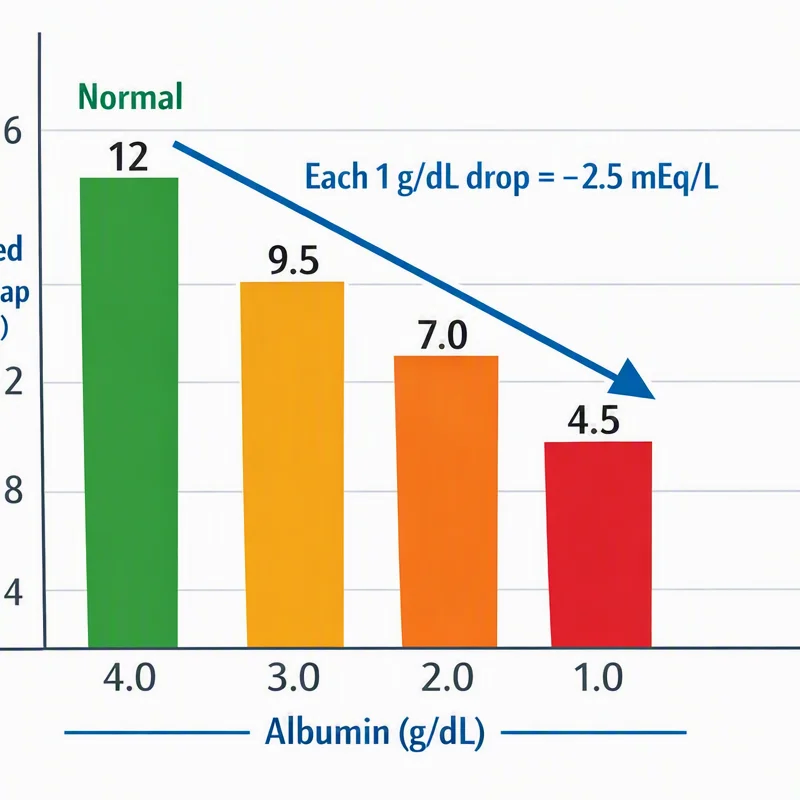
When albumin is decreased, clinicians often calculate a adjusted anion gap. This adjustment helps restore the result closer to what would be expected at a typical albumin level. Without this step, the value may appear within the apparent reference range even when clinically important acids are present.
A common approach is to increase the measured anion gap by a set amount for each decrease in albumin below normal. Different institutions may use slightly different formulas, so the exact method should follow local practice. The important point is that low albumin can lead to underestimation of the true acid burden.
This is especially important in hospitalized patients, those with chronic illness, and patients undergoing critical care. In these settings, hypoalbuminemia is common and can alter both the interpretation and the urgency of further workup.
Stepwise Example Calculations
Here is a sample computation using typical laboratory numbers. This illustrative example shows how the formula for the anion gap is implemented in everyday use.
First example: Basic calculation
Serum sodium = 140 mEq/L
Serum chloride = 102 mEq/L Serum bicarbonate = 24 mEq/LUsing the anion gap equation:
140 − (102 + 24) = 14
The anion gap is 14. If this is normal depends on the laboratory’s reference interval and whether potassium is included in the formula. If the result is near the upper end of the lab’s range, it may still be clinically acceptable, but the full context matters.
Example 2: Elevated anion gap
Serum sodium = 138 mEq/L
Serum chloride = 100 mEq/L Serum bicarbonate = 14 mEq/L138 − (100 + 14) = 24
This is significantly elevated in many settings and may suggest high anion gap metabolic acidosis. Causes such as lactate-related acidosis, ketone-related acidosis, renal insufficiency, or toxic alcohol exposure should be considered.
Example three: Albumin correction
Suppose the measured anion gap is 10 and albumin is low. After correcting for albumin, the albumin-corrected anion gap may rise into a higher range, revealing an abnormality that the uncorrected value missed. This is a common reason why albumin should always be reviewed when interpreting an electrolyte panel.
This set of examples show why the calculator is a starting point, not the final answer. The number must be connected to symptoms, physical findings, and other testing.
Restrictions and When to Seek Medical Review
Although a well-made calculator has boundaries. A falsely abnormal result can occur because of testing error, collection problems, or transcription mistakes. For this reason unexpected results should be rechecked before making major decisions.
The anion gap is only one part of acid-base evaluation. It does not replace an blood gas study, a full electrolyte panel, or assessment of kidney function, glucose, lactate, and ketones when needed. It also does not identify the reason of an abnormal result on its own.
Because interpretation affects healthcare decision-making, urgent symptoms should never be ignored. If a patient has severe weakness, confusion, rapid breathing, chest pain, dehydration, or altered mental status, prompt evaluation may be needed. In some cases, urgent care or emergency assessment is appropriate.
For anyone using an anion gap calculator as part of self-review or clinical screening, the best approach is to treat the result as a guide. If the number is unexpected, significantly high, or paired with concerning symptoms, professional review is important.
FAQ
What is an anion gap calculator used for?
An anion gap calculator is used to estimate the anion gap from blood test values and help assess acid-base balance. It is commonly used to screen for acid buildup, identify possible unmeasured acids, and support lab interpretation of an electrolyte panel.
What is a normal anion gap range?
The normal anion gap depends on the laboratory’s normal range and whether potassium is included in the formula. In general, the result should be interpreted using the lab’s own reference interval rather than a single universal cutoff.
How do you calculate the anion gap from lab values?
Use the gap formula: sodium minus the sum of chloride and bicarbonate. In other words, anion gap = serum sodium − (serum chloride + serum bicarbonate). Some versions include K, but many calculators omit it.
Why does low albumin levels affect the anion gap?
Albumin is a negative-charge protein and a major unmeasured anion. When albumin is low, the measured anion gap may seem lower than it truly is. That is why albumin correction is important and why a corrected anion gap may be more reliable in patients with hypoalbuminemia.
What conditions can cause a high anion gap?
Common causes of high anion gap metabolic acidosis include lactic acidosis, ketoacidosis, renal failure, and toxic alcohols. Other causes may also exist, so the result should always be reviewed with the full clinical picture and, when appropriate, an arterial blood gas and other blood test results.